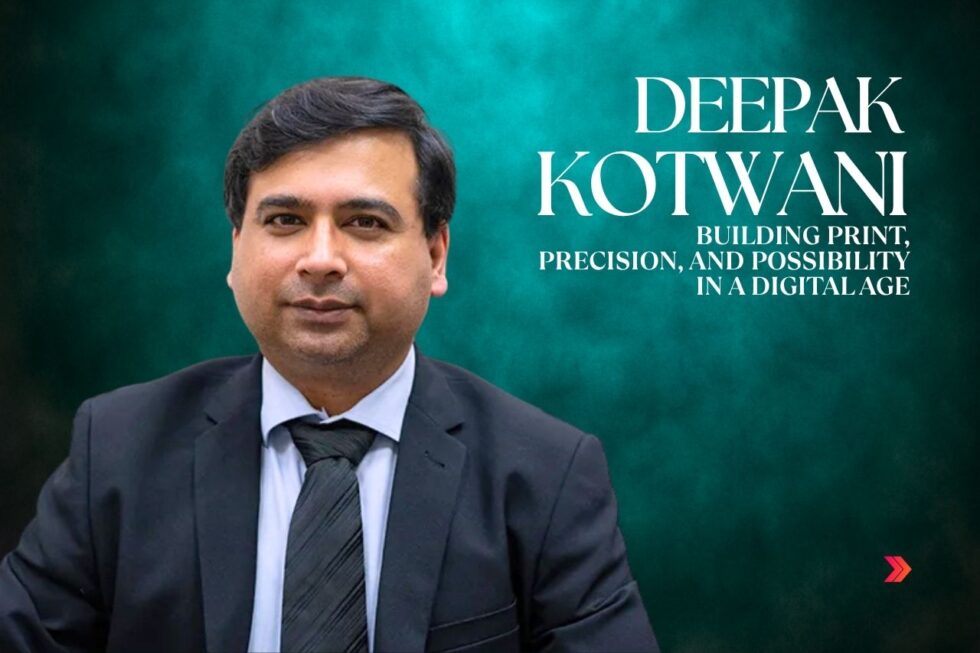
In an era where screens dominate communication and digital platforms shape brand identity, the relevance of print has often been questioned. Yet, for businesses that understand the value of tactile experience, precision, and visual impact, print remains not just relevant but essential. At the center of this enduring industry in the UAE stands Deepak Kotwani, a professional whose work reflects a clear understanding of both tradition and transformation.
As the driving force behind Repografix, Kotwani has spent years building a reputation rooted in reliability, consistency, and forward-thinking execution. His journey is not defined by sudden breakthroughs or headline-grabbing disruption, but by a steady, deliberate approach to business, one that has allowed him to navigate changing market demands while maintaining a strong operational foundation.
A Foundation Built on Practical Insight
Kotwani’s professional path reflects a deep familiarity with the mechanics of printing, production, and client servicing. Rather than approaching the industry from a purely commercial perspective, he has remained closely connected to its technical and operational aspects. This hands-on understanding has played a significant role in shaping the way Repografix operates today.
From large-scale commercial printing to customized corporate materials, the company has developed capabilities that serve a wide spectrum of clients. The focus has always been clear: deliver quality without compromise, maintain timelines, and ensure that every output aligns with the client’s expectations.
In a market like Dubai, where competition is intense and client expectations are high, such consistency becomes a differentiating factor. Businesses are not simply looking for vendors; they are looking for partners who understand urgency, branding, and execution. Kotwani’s approach has positioned Repografix within that space.
Navigating a Changing Industry
The printing industry has undergone significant change over the past decade. The rise of digital marketing, automation, and online platforms has forced traditional businesses to rethink their strategies. For many, this transition has been challenging.
Kotwani’s response, however, has been measured rather than reactive. Instead of viewing digital transformation as a threat, he has treated it as an opportunity to refine services and expand capabilities. This includes integrating modern technologies into production processes, improving turnaround times, and adapting to new forms of client demand.
The result is a business that retains its core strength in print while aligning itself with contemporary requirements. Whether it is short-run digital printing, customized branding materials, or high-quality large-format outputs, Repografix reflects a blend of traditional craftsmanship and modern efficiency.
The Value of Detail in a Fast-Paced Market
One of the defining aspects of Kotwani’s professional philosophy is attention to detail. In printing, precision is not optional; it is fundamental. A minor error in color calibration, alignment, or finishing can significantly impact the final product.
This emphasis on detail is evident in the company’s output. Clients across sectors, including retail, corporate, hospitality, and events, rely on Repografix for materials that represent their brand accurately. From business cards and brochures to signage and promotional displays, every piece carries the expectation of quality.
In a city known for its visual standards and presentation, this level of consistency becomes critical. Dubai’s business environment is driven by perception as much as performance, and Kotwani’s work aligns closely with that reality.
Building Long-Term Relationships
While technical capability is essential, long-term success in service-driven industries often depends on relationships. Kotwani’s approach to client engagement reflects an understanding of this dynamic.
Rather than focusing solely on transactional interactions, Repografix has developed ongoing partnerships with many of its clients. This is built on trust, reliability, and the ability to deliver under pressure. In industries such as events and exhibitions, where timelines are tight and expectations are high, such reliability is particularly valuable.
Clients often return not just because of the quality of work, but because of the confidence that their requirements will be understood and executed without unnecessary complications. This level of dependability is not easily achieved, and it speaks to the operational discipline that Kotwani has instilled within the organization.
Leadership Through Consistency
Leadership in business is often associated with innovation, expansion, or rapid growth. While these elements are important, Kotwani’s leadership style is better described as consistent and grounded.
He has focused on building a stable operational structure, ensuring that processes are efficient, teams are aligned, and output remains reliable. This approach may not always attract attention, but it creates a strong foundation for sustained growth.
In industries where fluctuations in demand are common, such stability becomes a competitive advantage. It allows the business to adapt without losing direction, and to scale without compromising quality.
Adapting to Client Expectations
Modern clients expect more than just a finished product. They expect speed, flexibility, and clarity. Kotwani’s approach reflects an understanding of these evolving expectations.
This includes offering quick turnaround solutions, maintaining transparent communication, and ensuring that production timelines are met without delays. The ability to handle urgent requirements without compromising on quality has become one of the defining strengths of Repografix.
At the same time, the company continues to invest in improving its processes, whether through upgraded equipment, refined workflows, or enhanced service models. This ongoing improvement ensures that the business remains relevant in a competitive market.
The Role of Print in a Digital World
Despite the growth of digital media, print continues to hold a unique position in branding and communication. Physical materials offer a level of engagement that digital platforms cannot fully replicate. They create a tangible connection, one that often leaves a lasting impression.
Kotwani’s work reflects a clear understanding of this balance. Rather than positioning print as an alternative to digital, he sees it as a complementary medium. Businesses that integrate both effectively are often able to create stronger, more cohesive brand experiences.
From corporate stationery to large-scale branding installations, print remains an essential part of how businesses present themselves. Under Kotwani’s leadership, Repografix continues to support this aspect of brand building with precision and reliability.
Looking Ahead
As industries continue to evolve, the ability to adapt without losing core strengths becomes increasingly important. Kotwani’s journey reflects this balance. By staying grounded in the fundamentals of quality and service, while remaining open to change, he has positioned his business for continued relevance.
The future of printing will likely involve greater integration with digital technologies, increased customization, and faster production cycles. Businesses that can navigate these changes effectively will continue to thrive.
For Kotwani, the path forward appears to remain consistent with the principles that have defined his work so far: focus on quality, maintain strong client relationships, and adapt thoughtfully to change.
A Quietly Built Legacy
In a city often defined by scale and speed, there is value in businesses that grow steadily, guided by discipline and clarity. Deepak Kotwani’s professional journey reflects exactly that.
Through Repografix, he has built more than a service provider. He has created a business that understands its role within a larger ecosystem, supporting brands, enabling communication, and delivering results that meet both expectation and intent.
It is a legacy not built on noise, but on consistency, precision, and trust—qualities that continue to hold value, regardless of how industries evolve.