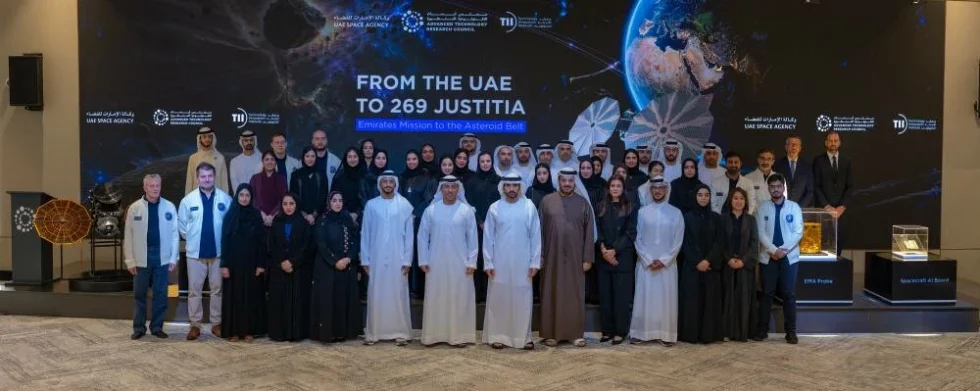
Dubai: His Highness Sheikh Hamdan bin Mohammed bin Rashid Al Maktoum, Crown Prince of Dubai, Deputy Prime Minister, Minister of Defence of the UAE and Chairman of the Supreme Space Council, witnessed the unveiling of the probe for the Emirates Mission to the Asteroid Belt (EMA).Developed, assembled and tested in the UAE, the probe reached flight readiness in less than two years and is set to embark on its journey aboard the MBR Explorer, the UAE’s second interplanetary mission.The mission will travel approximately 5 billion kilometres to explore seven asteroids, culminating at 269 Justitia, where the probe will separate from the spacecraft and descend autonomously to the asteroid’s surface.His Highness Sheikh Hamdan commended the scientists, engineers, researchers and national institutions that contributed to the project.”Guided by the vision of our leadership, the UAE has progressed in just a few years from aspiring to reach space to actively contributing to shaping its future,” His Highness said.”Since the establishment of the UAE Space Agency in 2014, the nation has developed an integrated national space ecosystem, launching satellites, placing the Hope Probe into orbit around Mars, and sending Emirati astronauts to the International Space Station. Today, we continue to advance lunar missions and increasingly ambitious exploration projects.”His Highness said the development of the probe in less than two years reflects the capabilities of Emirati talent and the strength of the UAE’s research, development and manufacturing ecosystem.Growing space ambitionsSheikh Hamdan noted that the UAE has rapidly expanded its presence in the global space sector.”In 2014, His Highness Sheikh Mohammed bin Rashid Al Maktoum, Vice President and Prime Minister of the UAE and Ruler of Dubai, launched the Emirates Mars Mission. In less than two decades, the UAE has established its position among the world’s leading spacefaring nations. Today, we are entering a new phase of advanced scientific missions, space industries and technologies.”His Highness added that the UAE space sector now exceeds Dh44 billion.”The UAE’s space sector today exceeds AED44 billion, and our ambitions for the next phase are even greater. By 2031, we aim to double the returns of the space economy, increase its added value by 60%, and position the UAE among the world’s top 10 space economies.””We are investing in Emirati talent, knowledge, technology and advanced industries to continue delivering achievements that contribute to our economy, our future and humanity.”HamdanNational collaborationThe UAE Space Agency leads and funds the Emirates Mission to the Asteroid Belt and oversees its implementation in partnership with national and international organisations.The mission’s national team includes more than 150 specialised engineers and scientists.The probe was developed through collaboration between the UAE Space Agency, the Technology Innovation Institute (TII), HEX20, Khalifa University, and the National Space Science and Technology Center at United Arab Emirates University.”The size of the UAE space sector today exceeds 44 billion dirhams, and we are working until 2031 to double the returns of the space economy and consolidate the UAE’s position among the top 10 strongest space economies globally,” says His Highness Sheikh Hamdan bin Mohammed bin Rashid Al Maktoum.His Excellency Dr Ahmad Belhoul Al Falasi, Minister of Sports and Chairman of the UAE Space Agency, said the probe’s readiness reflects the progress achieved by the UAE’s national space sector.”The probe reaching flight readiness reflects the advancement and capabilities of the UAE’s national space ecosystem and its ability to leverage ambitious missions to develop advanced technologies, strengthen integration between national institutions and companies, and develop specialised supply chains.”Launch planned for 2028The probe is scheduled to be integrated with the MBR Explorer at the Laboratory for Atmospheric and Space Physics (LASP) at the University of Colorado Boulder ahead of its planned launch from Japan in the first quarter of 2028.The mission’s final target, 269 Justitia, is believed to have formed in the outer regions of the Solar System before migrating to the main asteroid belt. Scientists hope studying the asteroid will provide insights into how water and organic materials were distributed during the formation of the planets.The unveiling comes as the UAE continues to expand its space sector under the National Space Strategy 2031, which aims to double the returns of the space economy and increase the sector’s added value by 60 per cent.Alongside the asteroid belt mission, the UAE is advancing programmes including the International Space Cooperation Programme, Altair-Next Gen, the Rashid Rover 2 mission and participation in NASA’s Artemis programme.